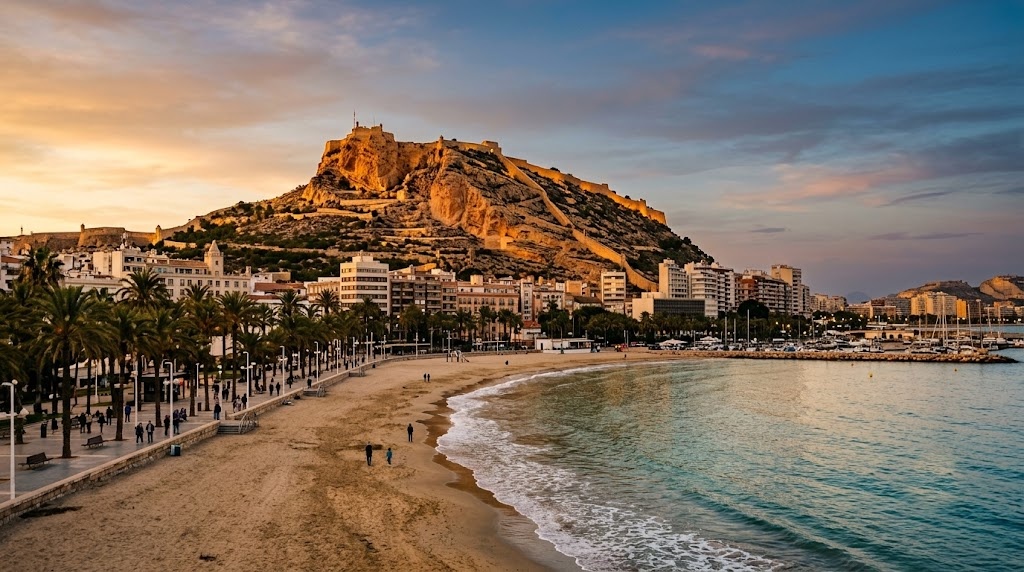
Alicante, the City Spain Kept for Itself
Castle Sunsets, Rice Worth a Pilgrimage, and a Tram That Runs Along the Beach
Alicante has spent decades in the shadow of Barcelona and Valencia — which is exactly why locals love it. A Moorish castle crowns the city for free, the old quarter drips with blue-and-white houses, and the food scene runs on market stalls and legendary tapas bars rather than tourist menus. Whether you're chasing 9th-century ramparts, the perfect arroz a banda, or a beach day the kids will talk about all year, Alicante moves at your speed — and in 2026, with Spain lifting the World Cup and Alicante topping Europe's trending-destination charts, the secret is officially out.
Featured Locations (4)
What's On
Alicante's patroness festival — the Alborada in Plaza del Ayuntamiento, 21-gun salutes at noon, and the solemn procession from the Co-Cathedral of San Nicolás through the old town.
The 185-year-old fishermen's-quarter fiesta — panquemao mornings, olleta at long street tables, the poalà water battle, and the sailors' Salve Marinera procession.
130+ Michelin and Repsol Soles chefs fill IFA-Fira Alacant — live showcookings, tastings, workshops; Mexico cooks as the invited country.
Alicante's 39th international puppet festival — carved rod marionettes and open-air street stages across the city; the city publishes the full programme in November.
Essential info
- calendar Best Time
- Mar-May & Sept-Oct for mild sun; June 20-24 for the Hogueras de San Juan bonfires
- map Getting Around
- TRAM d'Alacant — tap a bank card to board; runs along the coast to Benidorm & Dénia
- wallet Value
- Castle entry free, MACA free, menú del día lunches €10-18; Bono travel card ≈€0.42/trip
- footprints Pace
- Lunch 13:30-15:30, dinner after 20:30; many kitchens close 16:00-20:00 — plan around it
Everything cultural in Alicante radiates from Mount Benacantil, the rock that wears the 9th-century Castillo de Santa Bárbara like a crown. Below it, the Barrio de la Santa Cruz — home to barely 2,000 residents — stacks whitewashed houses and royal-blue doorways up staircases that predate the Reconquista. Down at sea level, the Explanada de España rolls out its famous promenade of more than six million tri-color marble tiles, and museums punch far above the city's size: the MARQ archaeological museum was named European Museum of the Year, and the contemporary-art MACA is free.
Local Insights for Cultural
- The Lift Trick: Castle entry is free — you only pay for the elevator bored through the rock opposite Postiguet beach (≈€2.70, card only, free over 65, and the ride down costs nothing). Locals ride up, then walk down through Santa Cruz's lanes. Do it near sunset.
- Find the Moor's Face: Look up at Mount Benacantil from Postiguet beach and the cliff resolves into a giant human profile — La Cara del Moro, the city's unofficial logo and its most photographed illusion.
- Tardeo Was Invented Here: Alicante's gift to Spain is partying in the afternoon — tapas and drinks from about 1pm, home by 10. It began at the Central Market's stalls; today Calle Castaños is the epicenter, packed every Saturday.
- Check Before Night Climbs: Summer evening castle visits are magical but the grounds sometimes close for private events with no warning — recent visitors have been turned away. Confirm same-day before hiking up after dark.
The Castle-to-Casco Antiguo Loop
- 10:00 AM
Take the elevator through 200m of rock from Calle Jovellanos. Explore all three levels — the Torreta keep at the top predates almost everything else in the city — plus the MUSA museum rooms and the Balcony of the Mediterranean.
- 12:30 PM
Skip the lift down. The footpath drops you into the old quarter's whitewashed lanes — flower pots, royal-blue joinery, laundry lines. Pause at the Ermita de Santa Cruz viewpoint before landing at the Basilica of Santa María.
- 3:00 PM
The free contemporary art museum sits in a 1685 baroque granary opposite the basilica. Round the corner to the Co-Cathedral of San Nicolás and hunt for the centuries-old painted inscriptions on its facade.
- 7:00 PM
Six million marble tiles ripple underfoot on Spain's prettiest promenade. Grab a horchata or join the tardeo crowd on Calle Castaños before a late dinner at La Ereta on the castle hillside.
Rule one, straight from local guides: the word 'paella' is practically banned here. Alicante is arroz country — arroz a banda cooked in fish stock, caldero made with ñora peppers, all served thin with a crackling socarrat crust and a spoon of real mortar-made alioli. The engine room is the Mercado Central, a century-old Modernist hall that ranks among Spain's biggest indoor markets, where salazones stalls sell mojama — salt-cured tuna locals call 'the ham of the sea.' And the tapas pedigree is world-class: chef Joël Robuchon reportedly called Nou Manolín's bar his favorite anywhere, and copied it in his own restaurants.
Local Insights for Foodie
- Order Rice, Never 'Paella': Locals joke that if a menu says paella, walk out. Ask for arroz a banda or caldero alicantino — one thin layer of rice, intense broth, crispy socarrat edges — and drag every forkful through the alioli.
- The Barra Beats the Table: At Nou Manolín (since 1972) the ground-floor bar takes no reservations and serves the best seats in the house. Arrive right at opening or queue — the calamares a la romana recipe hasn't changed in fifty years.
- Market Souvenir: At the Mercado Central's salazones stalls, ~€5 buys 80g of mojama sliced off the block. Eat it the local way — drizzled with olive oil, scattered with Marcona almonds.
- Turrón Geography: The hard almond nougat is 'Alicante'; the soft version is 'Jijona,' made in a town 30km inland. Buy the supreme grade in town year-round — Spaniards save it for Christmas, but nobody's checking.
A Rice-Country Grazing Day
- 9:30 AM
Tostada con tomate and café con leche at a market bar, then browse the salazones stalls downstairs — mojama, hueva, smoked bonito — and the hanging Vinalopó grapes upstairs. The building just turned 100.
- 1:30 PM
Claim a stool at Alicante's most famous bar counter — the one Joël Robuchon fell for. Calamares, gambas, whatever the kitchen suggests. No bookings at the bar; that's the point.
- 5:30 PM
Pick up supreme-grade turrón near the Co-Cathedral, then join the paseo with a scoop from Livanti — Sicilian gelato rated among Spain's top three (cash only).
- 9:00 PM
End at El Caldero on Calle Virgen del Socorro for the fisherman's rice made with rock-fish broth and ñora peppers — or book Valencia Once, where locals swear the city's best rice hides near the bullring.
Alicante might be Spain's easiest city with kids: the beach is in the city, the castle has dungeons and cannons, and the tram doubles as a ride. Postiguet's shallow water sits right under the castle rock, while 20 minutes up the tram line the 6km sweep of Playa de San Juan opens up with pedal boats and beach restaurants. Boats from the marina cross to Tabarca, Spain's first marine reserve, where kids snorkel over seagrass in a walled fishing village. And when the afternoon sun peaks, the MARQ museum hands out children's activity booklets and lets them man a dig site indoors, in air conditioning.
Local Insights for Family
- The Tram Is the Hack: Tap any contactless bank card to board the stroller-friendly TRAM. A rechargeable Bono card (€2) drops trips to about €0.42, and a 24-hour all-zone pass runs ≈€5.
- San Juan's Secret: Only one hotel sits on the entire 6km beach, so it stays remarkably local even in July. Trams run every 10 minutes along six beachfront stops — hop off wherever looks emptiest.
- Tabarca Kit List: Pack water shoes and snorkels — the island's coves are rocky, and the marine-reserve water is the clearest on the coast. Ferries leave from the marina below the castle.
- Car-Seat Warning: Alicante taxis generally don't carry child seats. Pre-book airport transfers with seats (the airport is only 20 minutes out), or skip the car entirely — the tram honestly covers it.
Family Day: Sandcastles to Real Castles
- 9:00 AM
Start on the city beach while it's cool — shallow water, summer lifeguards, and a playground on the sand. Look up and find the Moor's Face in the cliff above.
- 11:30 AM
Twenty minutes on Line 3 to six kilometres of golden sand. Rent a pedal boat, then lunch at a chiringuito — Casa Julio and Casa Domingo are the local rice classics on this stretch.
- 3:00 PM
While the town naps, kids dig into interactive Stone Age-to-Rome exhibits with free activity booklets at the European Museum of the Year winner. The Museo de Hogueras (free) is the backup — giant carnival figures saved from the flames.
- 5:30 PM
Finish in the palm-shaded park at the city's edge: playgrounds, waterfalls, and rowboats on the lake. Tomorrow: the boat to Tabarca, or the tram to Villajoyosa's Valor chocolate museum (free samples).
Top Places to Try
Curated spots for all
Questions
Do I need a car in Alicante?
No — the TRAM d'Alacant runs along the coast from the city to San Juan, El Campello, Villajoyosa, Benidorm and on to Dénia. Tap a contactless bank card to board, or get a €2 Bono card for ~€0.42 trips.
When are the Hogueras de San Juan, and is it worth planning around?
June 20-24 every year: giant satirical sculptures fill the streets, daily mascletà fireworks shake Plaza de los Luceros, and on the final night the figures burn while firefighters soak the crowd. Book far ahead — or visit the free Museo de Hogueras any time to see rescued figures.
Do restaurants need booking?
The famous bar counters (Nou Manolín, El Cantó) don't take reservations — arrive at opening. For dining rooms like La Ereta, Valencia Once or La Taberna del Gourmet, book days ahead, especially weekends.
Is the castle really free?
Yes — walking in costs nothing. You only pay for the elevator from Postiguet beach (≈€2.70, card only, over-65s free, descent free). One caveat: summer evenings occasionally close for private events, so check the same day before a night visit.
Alicante is what happens when a city built for its own people suddenly gets the world's attention: unhurried, affordable, sun-drunk, and quietly confident. Come for the trending-destination headlines and the World Cup afterglow — stay for the rice crust, the castle at golden hour, and a tram ride where every stop is a beach.