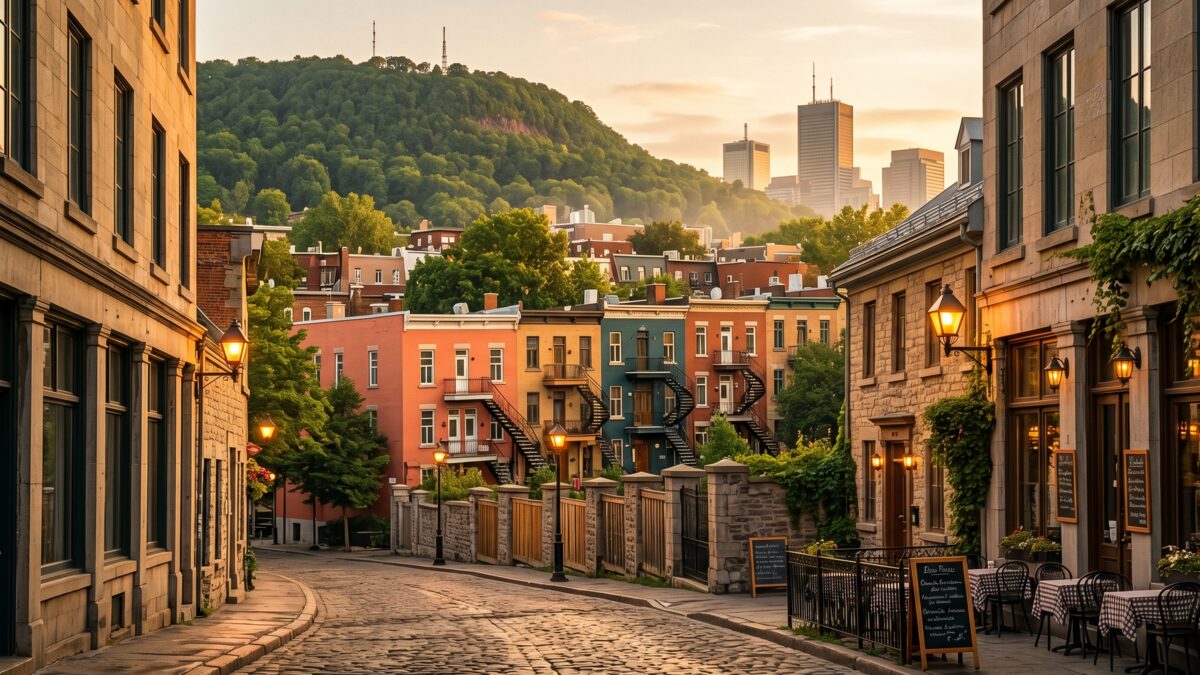
Montreal's Three Tempos
A Neighborhood Guide to Old Port Stones, Plateau Bistros, and Mile End Bagels
Montreal is small enough to walk through and big enough to feel like three different cities. Most first-time exploration centers on Vieux-Montréal, where seventeenth-century stone walls and the Old Port sit a few blocks apart. From there, the city opens north into Le Plateau-Mont-Royal — bistros, terrasses, and the green spine of Parc La Fontaine — and further into Mile End, the bagel-and-café neighborhood where Montreal's food identity is easiest to taste in a single morning. The mountain itself sits in the middle, walkable from any of them. In summer the whole city tilts toward the Quartier des Spectacles, which stacks one of the densest festival calendars in the world from early June through early August.
Featured Locations (7)
What's On
46th edition — 350-plus shows in the Quartier des Spectacles, two-thirds free and outdoors, open-air stages running nightly until midnight.
Vietnamese night market on Bassin Peel — 22 food stalls, most plates under $10, lanterns and live sets over the water; $5 entry.
The pride festival's 20th edition — eleven days of free outdoor stages in the Village and the parade down René-Lévesque on the closing Sunday.
33rd edition: costumed merchants, bobbin-lace and old-trade demos, Indigenous know-how, French Regime music and dance on Place Royale. Free, 10–5.
Three cultural gardens lit after dusk for a 14th edition — hundreds of silk lanterns on Dream Lake, Resonance in its 25th year.
1,000 riders, 13 events over eight days — every finish on Avenue du Parc below Mount Royal. Montreal's first Worlds since 1974.
25th edition: 400+ bands across 50+ venues, most of them walkable inside Mile End and the Plateau.
55th edition — nearly 200 films from more than 30 countries across six downtown venues; opens with Denis Côté's Nobody's Violence at the Monument-National.
Forty artisan chalets across Place des Festivals: Quebec makers, mulled wine and over 150 free shows. Free admission.
Essential info
- map Primary Base
- Vieux-Montréal or Le Plateau
- utensils Best Food Neighborhood
- Mile End + Little Italy (Marché Jean-Talon)
- clock Festival Season 2026
- MURAL (Jun 4–14) → Jazz Fest (Jun 25–Jul 4) → Just for Laughs (Jul 15–26) → Osheaga + Pride (Jul 31–Aug 9)
- clock Best Walking Windows
- Mid-morning and after 6pm in summer (long northern light, festival stages light up)
- footprints How to Move
- Walk within each neighborhood; STM metro or BIXI bike between them
- clock Pacing Tip
- Pick one neighborhood per half-day. Montreal punishes cross-city sightseeing days.
This is the obvious first-day anchor — cobblestone streets, the Notre-Dame Basilica, the Old Port. The neighborhood is compact enough that you don't need a plan; the church bells, the river, and Place Jacques-Cartier do the work.
Le Plateau is where the city slows down. Painted spiral staircases, indie bookstores, French bistros, and Parc La Fontaine's two ponds. This is the residential heart of francophone Montreal and the right base for travelers who want bistros over landmarks.
Mile End is a half-mile of bagel ovens, Greek diners, second-wave cafés, and indie bookshops sitting on top of each other. The neighborhood's food density per block is the highest in the city, which is why it's the natural foodie base — even if you don't stay here, plan to eat here.
Essential info for Foodie
- utensils Best Food Base
- Mile End for daytime, Plateau for evening
- utensils Best Market
- Marché Jean-Talon (Saturdays are peak)
- utensils Dining Logic
- Small portions across multiple stops — Montreal eats are designed to be sampled, not committed to
- clock Festival-Week Reservations
- Book Plateau bistros 10–14 days ahead during Jazz Fest (Jun 25–Jul 4) and Just for Laughs (Jul 15–26)
- clock Good to Know
- Bagels are 24/7 at Fairmount, near-24/7 at St-Viateur. Mile End is busiest Saturday afternoons.
- utensils Must-Try Montreal Foods
- Montreal bagel, smoked meat sandwich, poutine, tourtière, schmear-and-lox, espresso at a Mile End café, maple-glazed everything in season
The bagel rivalry between St-Viateur (1957, wood-fired oven, 263 Rue Saint-Viateur Ouest) and Fairmount (1949, the original, 74 Avenue Fairmount Ouest) sits three blocks apart. Locals have opinions; the honest answer is to buy a dozen of each and decide on the sidewalk. The morning loop works because everything you need — bagels, cream cheese, smoked salmon, espresso, a bookstore to read in — is inside a 600-meter circle.
Morning Bagel Loop — Mile End (90–120 Minutes)
- 08:30
Start here while the line is still short. Order a half-dozen sesame, fresh out of the oven. Eat one standing up; the residual heat is the entire experience.
- 09:00
Compare side-by-side. Fairmount is open 24/7 and is the original Montreal bagel bakery — sweeter dough, slightly thinner crust. Buy a half-dozen of the other variety.
- 09:30
Mile End's Italian-Quebecois café tradition. Stand at the bar like a local. No laptops; this is a conversation room.
- 10:00
Independent comics-and-literary publisher with a storefront on Bernard. The right place to slow down before lunch and read your bagel-flecked book.
- 10:30
Indie record shops, Greek diners, vintage clothing. Walk west to east before the Saturday crowds arrive.
Marché Jean-Talon in Little Italy is Montreal's biggest open-air public market — produce stands, fromageries, a Boucherie row, Quebec maple products, and the city's best fruit. Go on a Friday or Saturday morning when farmers from Île d'Orléans and the Eastern Townships are at the stalls themselves. The neighborhood around it (Petite-Italie) is the right place for a sit-down lunch — espresso, panini, Sicilian-Quebecois pizza al taglio.
Midday Market Drift — Marché Jean-Talon & Little Italy (90 Minutes)
- 11:30
Walk the outer ring first (produce, flowers, maple) before the inner shops (fromageries, charcuteries). This is the orientation pass.
- 12:00
Quebec cheeses tasted at the counter — Riopelle, Migneron, 1608. Then olives, dried herbs, harissa.
- 12:30
Petite-Italie sit-down, twenty meters from the market. Stand at the bar for the local rhythm; sit on the terrasse for the slow version.
- 13:15
Cannoli at Alati-Caserta is a Little Italy ritual since 1968. In season, finish with maple soft-serve at one of the market stands.
Dinner on Boulevard Saint-Laurent — "the Main" — is one of the most cinematic experiences in the city. The street is the historical dividing line between francophone east and anglophone west Montreal, lined with immigrant institutions and chef-driven bistros. Schwartz's Deli (since 1928, 3895 Boulevard Saint-Laurent) is the smoked-meat temple. Then walk south for the Plateau bistros — Au Pied de Cochon, L'Express, Joe Beef in nearby Little Burgundy — or stay close for natural-wine bars.
Evening on the Main — Schwartz's to Plateau Bistros (2–3 Hours)
- 17:30
Order "medium fat" — the local default. Cherry Coke, half-sour pickle, ten minutes at the counter. The line is shorter at 5:30 than 7:30.
- 18:15
Pass the murals from the MURAL Festival (Jun 4–14), neon old-Montreal Jewish-immigrant signage, and the next generation of natural-wine bars taking it over.
- 19:00
Au Pied de Cochon for Martin Picard's Quebec maximalism (foie gras poutine); L'Express for the unchanged 1980 Parisian-Plateau bistro — steak tartare, fries, escargots.
- 21:00
Plateau version: Vin Mon Lapin or Ma'tine for low-intervention pours. Old-Port version: rooftop terrasse with Jacques-Cartier Bridge views.
If you have a second food day, Marché Atwater on the Lachine Canal is the south-end counterpart to Jean-Talon — smaller, more chef-curated, with a riverside picnic table built in. Bring a baguette, fromage, and charcuterie from inside the market hall and eat them on the canal bike path. The BIXI rental docks are at the market gates.
Local Insights for Foodie
- Mile End mornings beat Mile End afternoons — the bagel ovens run hottest before 10am and the lines triple after noon on weekends
- Treat Schwartz's like a stand-up bar: order "medium fat," eat at the counter, leave in 20 minutes — that's the actual experience
- Marché Jean-Talon is for grazing, not for a single meal — bring a tote bag and snack across six stalls instead of committing to one restaurant
- During Jazz Fest (Jun 25–Jul 4) and Just for Laughs (Jul 15–26), Plateau bistros fill up two weeks ahead — book before you fly in or pivot to walk-in counter seats
Montreal's food story is most legible across one foodie day: bagels and espresso in Mile End by mid-morning, market grazing in Little Italy by lunch, and smoked meat plus a Plateau bistro after dark.
Essential info for Cultural
- map Best Cultural Base
- Vieux-Montréal for landmarks, Plateau for arts, Quartier des Spectacles for festivals
- clock Summer 2026 Festival Window
- MURAL Jun 4–14 · Jazz Fest Jun 25–Jul 4 · Just for Laughs Jul 15–26 · Osheaga Jul 31–Aug 2 · Fierte Pride Jul 31–Aug 9
- map Key Cultural Anchors
- Notre-Dame Basilica, Musée des beaux-arts (MBAM), Saint-Joseph's Oratory, Pointe-à-Callière, Mount Royal Park, Quartier des Spectacles
- footprints Pacing Style
- One major site per half-day. Festival nights are the bonus round — add a free evening Quartier des Spectacles stage to any cultural day in season.
Notre-Dame Basilica is the clearest cultural starting point. The 1824 Gothic Revival interior — deep blue vaulted ceiling, gold-leafed stars, an organ with 7,000 pipes — is genuinely cinematic. Buy timed tickets in advance; the Saturday-afternoon walk-up line stretches around the block. Then walk Rue Saint-Paul (the city's oldest street), Place Jacques-Cartier, and the Old Port edge.
Morning Walk — Vieux-Montréal Heritage Loop (2 Hours)
- 09:00
Arrive at opening (9am Mon–Fri, 9am Sat). The deep-blue vaulted ceiling and gold-leaf stars are the room's signature. Allow 45 minutes minimum.
- 09:45
Exit onto Place d'Armes, the seventeenth-century square framed by the basilica and the Bank of Montreal. Walk one block east on Saint-Sulpice for the quietest views.
- 10:15
Cobblestone street running parallel to the river since the 1670s. Galleries, design stores, the Marguerite-Bourgeoys Chapel (the "Sailors' Church") at the eastern end.
- 10:50
Built directly over the city's founding excavation site. The 18-minute multimedia show gives you the 400-year arc of the city in one room.
The Musée des beaux-arts de Montréal (MBAM) is the country's most-visited art museum and the second cultural anchor. Five pavilions on Rue Sherbrooke house ~47,000 works spanning Indigenous art, Quebec painting, the great European collection, and the Michal & Renata Hornstein Pavilion for Peace. Closed Mondays. The free permanent collection (with paid admission to special exhibits) makes it an easy two-hour pause.
Midday Museum Drift — Sherbrooke Corridor (2.5 Hours)
- 13:00
The newest pavilion houses the international art collection and rotating temporary shows. Best top-down route through the museum.
- 14:15
The Quebec painters (Riopelle, Borduas, Pellan) and the Indigenous Art collection. The room most travelers skip and most locals come back to.
- 15:00
The grand 19th-century Sherbrooke — university gates, the old Ritz Carlton, the McCord Stewart Museum (Montreal social history). Stop at McCord if Indigenous and immigrant history interests you.
The cultural day's third act is the mountain itself. Saint-Joseph's Oratory — the largest church in Canada, with the largest dome — sits on the west slope and is one of the city's most distinctive built objects. Then loop up to the Kondiaronk Belvedere lookout on the south face for the city's signature view. The Belvedere is named for the Wendat (Huron) chief who signed the Great Peace of Montreal in 1701, the cultural footnote most travelers miss.
Late Afternoon — Mount Royal Cultural Loop (2 Hours)
- 16:00
Founded 1904 by Saint Brother André. Climb the 283 steps (some pilgrims do them on their knees), tour the votive chapel of 10,000 candles, then the dome basilica — the largest in Canada.
- 17:00
From the Oratory it's a 45-minute walking ascent through the woods, or a short Uber to the Voie Camillien-Houde lot near the top.
- 17:45
The wide stone terrace was designed by Frederick Law Olmsted (who also did Central Park). Best 60 minutes before sunset; the skyline reads east-to-west left to right.
Summer 2026 turns the Quartier des Spectacles — the eight-block downtown arts district anchored on Place des Festivals — into a free open-air theater for almost ten weeks straight. The light installations stay up year-round, but from early June through early August the district hosts MURAL, Jazz Fest, Just for Laughs, Osheaga, and Pride. The free outdoor stages run every night during each festival; ticketed venues (Place des Arts, Club Soda, MTelus, L'Astral) handle the headliners. If you only do one festival evening, pick a Quartier des Spectacles main-stage night and walk down from a Plateau dinner.
Summer 2026 Festival Calendar — Quartier des Spectacles
- Jun 4–14
Boulevard Saint-Laurent pedestrianized from Sherbrooke to Mont-Royal. Storey-high murals painted live, street food, free outdoor music. The festival closes a week before Jazz Fest opens — the murals stay up permanently.
- Jun 25–Jul 4
46th edition. 350+ concerts at Place des Festivals, two-thirds of them free. 2026 headliners include Lionel Richie & Earth Wind and Fire, St. Vincent, Diana Krall, Patrick Watson, and a tribute to J Dilla led by DJ Jazzy Jeff.
- Jul 15–26
World's biggest comedy festival. Free outdoor shows at Place des Festivals; ticketed headliners at Olympia, MTelus, Club Soda, Le Gesu, and Espace Saint-Denis. 2026 expanded to a parallel Quebec City edition.
- Jul 31–Aug 2
19th edition at Parc Jean-Drapeau. 2026 headliners: Lorde, Twenty One Pilots, Tate McRae. 26 Canadian acts on the bill. Shuttle from Jean-Drapeau metro or the dedicated festival shuttle.
- Jul 31–Aug 9
11 days, 750,000 attendees across three downtown hubs. The Defile de la Fierte (parade) on Sunday Aug 9 runs east on Rene-Levesque from St-Mathieu to Sanguinet — watching alongside Place des Festivals catches it at the apex.
Local Insights for Cultural
- Notre-Dame Basilica is best at 9am opening on a weekday — the Saturday-afternoon line is hours long and the room is meant for stillness, not crowds
- The MBAM permanent collection is free; only the special exhibitions need a ticket. Locals come for two hours on a rainy afternoon.
- Time your trip to overlap one festival — the Quartier des Spectacles runs free nightly outdoor stages during MURAL (Jun 4–14), Jazz Fest (Jun 25–Jul 4), and Just for Laughs (Jul 15–26). One free festival night often beats two paid daytime attractions.
- Festival hotels book out 4–6 weeks ahead in the Quartier des Spectacles + Plateau zone during the late-June through early-August window. If you're booking inside that window, lean Mile End or Vieux-Montréal instead.
Montreal's cultural day reads cleanest when split into four geographies: stone-and-faith heritage in Vieux-Montréal, the Sherbrooke museum corridor for art, the mountain for the city's defining view, and the Quartier des Spectacles for the summer festival circuit.
Essential info for Family
- map Best Family Base
- Vieux-Montréal (walkable, attractions clustered)
- map Big-Day Family Anchor
- Espace pour la Vie at Olympic Park (Biodôme + Insectarium + Botanical Garden)
- footprints Best Outdoor Afternoon
- Vieux-Port + Bonsecours Basin playground + Grande Roue ferris wheel
- clock Family-Friendly Festival Window
- Free daytime shows at Just for Laughs (Jul 15–26) and MURAL (Jun 4–14) work cleanly with kids
- footprints Quiet Reset
- Beaver Lake on Mount Royal (paddleboats summer / skating winter)
- clock Pacing Logic
- One indoor anchor + one outdoor afternoon per day. Avoid stacking two big indoor museums.
Espace pour la Vie at Olympic Park is the single most family-efficient stop in the city. Four museums on one campus: the Biodôme (five Americas ecosystems under one roof), the Insectarium (newly redesigned 2022, North America's largest insect collection), the Jardin botanique (75 hectares, three cultural gardens), and the Planetarium. Buy a multi-museum pass; do two on day one and save the others. Kids burn out before parents do.
Olympic Park Morning — Biodôme + Insectarium (3–4 Hours)
- 09:00
Opens 9am daily. Pie-IX metro station drops you 5 minutes from the gates. Buy a 2-museum or 4-museum pass online to skip lines.
- 09:15
Tropical rainforest → Laurentian forest → St. Lawrence marine → sub-polar islands → Antarctic penguins. Allow 90 minutes; the loop is one-way and stroller-friendly.
- 11:00
Newly renovated 2022 — the immersive Great Vivarium has free-flying butterflies. Best timed for late morning when the butterflies are most active.
- 12:30
The Jardin Botanique restaurant has a terrasse over the gardens. Reasonable family pricing for a museum café; reservations help on weekends.
The Vieux-Port is the family-friendly counterpart to Vieux-Montréal's cobblestone heritage. The 2.5-km waterfront walk runs from Pointe-à-Callière east to the Clock Tower Beach, with built-in stops kids actually want: the Grande Roue ferris wheel (the tallest observation wheel in Canada), the Bonsecours Basin (paddleboats summer, skating winter), the Voiles en Voiles aerial pirate park, and the playground beside the basin. Everything is free to walk; you pay only for the rides you choose.
Old Port Afternoon — Waterfront with Kids (3 Hours)
- 14:00
The cobblestone square spills into the Old Port. Buskers, sketch artists, an ice cream stand at the bottom. Set the tempo here.
- 14:30
60m tall, climate-controlled gondolas, 4 rotations over ~20 minutes. Best time is afternoon for skyline views; book ahead in peak summer.
- 15:15
Paddleboats in summer (rentals at the basin), the largest open-air ice rink in the city in winter, and a generous shaded playground.
- 16:30
Tree-top obstacle course rigged as pirate ships. Three difficulty levels, including a toddler course. Best for ages 4+.
Mount Royal is the right slow morning — a quieter, less-stroller-hostile counterpart to the Vieux-Port. Beaver Lake (Lac aux Castors) sits in a meadow at the top of the park with paddleboats in summer, a refreshment chalet, and gentle paths that work with strollers. From the lake it's a 15-minute walk to the Kondiaronk Belvedere lookout. The whole loop is closer to a long walk in the park than a hike.
Mount Royal Family Loop (2–2.5 Hours)
- 10:00
Free morning parking, paid after 11am. The lot is 5 minutes from the lake on a paved path.
- 10:30
Paddleboat rentals open in summer 10am–6pm. In winter this is the largest groomed cross-country ski trailhead in the city. The chalet has restrooms and snacks.
- 11:30
1.5 km, mostly flat, stroller-friendly carriage road designed by Olmsted himself (yes, same person who did Central Park). The trees open into the city view at the top.
- 12:15
Snack on the wide stone terrace. The city skyline reads east-to-west. Bring a small blanket; benches fill up at lunch.
Local Insights for Family
- Espace pour la Vie is the highest single-day RoI for families in Montreal — buy the 2-museum pass and don't try to do all four
- The Vieux-Port works best as an afternoon, not a morning — the buskers, ferris wheel, and ice cream stands all hit their stride after 2pm
- Mount Royal Beaver Lake is the right counterweight to museum days — open meadow, paddleboats, real shade
- Just for Laughs (Jul 15–26) runs a free family afternoon program at Place des Festivals — strollers welcome, often the easiest 'cultural' hour of the trip
Montreal fits family travel best when grouped into three half-days: Espace pour la Vie for the indoor anchor, the Vieux-Port for the waterfront afternoon, and Mount Royal Beaver Lake for the slow morning. In festival season add a free Quartier des Spectacles afternoon as the easy fourth.
Questions
Is Montreal walkable for first-time visitors?
Yes — Vieux-Montréal, the Plateau, and Mile End are each compact and walkable on their own. Use the STM metro or BIXI bikes to shift between neighborhoods; you do not need a car.
Which area is best to stay in?
Vieux-Montréal for landmark proximity and walkability to the Old Port; Le Plateau for bistros, terrasses, and neighborhood feel. Mile End is excellent if your trip is primarily food-driven. During festival weeks (late June through early August), lean Mile End or Vieux-Montréal — the Quartier des Spectacles + Plateau zone books out 4–6 weeks ahead.
When is the best time to visit Montreal in 2026?
Late June through early August. The summer 2026 festival stack runs MURAL (Jun 4–14), Festival International de Jazz (Jun 25–Jul 4), Just for Laughs (Jul 15–26), Osheaga (Jul 31–Aug 2), and Fierte Pride (Jul 31–Aug 9). Note that the F1 Canadian Grand Prix moved earlier in 2026 (May 22–24). Late September brings foliage on Mount Royal and quieter streets.
What should I eat first?
A Montreal bagel from St-Viateur or Fairmount in Mile End, and a smoked-meat sandwich (medium fat) at Schwartz's. Both are 1920s–1950s institutions and the most efficient introduction to the city's food identity.
Do I need festival tickets?
Not for most of it. Two-thirds of Jazz Fest concerts and most of MURAL, Just for Laughs' Place des Festivals shows, and Pride are free outdoor programming. Buy tickets only for specific headlining acts at Place des Arts, MTelus, Olympia, or Club Soda — and for Osheaga, which is a paid weekend pass.
How much French do I need?
Service is bilingual in Vieux-Montréal, downtown, Mile End, and the Plateau. A polite "bonjour" opens any conversation; staff will switch to English if you respond in English. East-end neighborhoods are more francophone but still tourist-friendly.